
How Can I Help My Child With Handwriting Practice at Home?

Quick & Easy Less Than 10 Min Assessment To Find Where Your Child May Be Falling Behind
Fill out the form and we’ll send you a free assessment to help you identify your child’s strengths and possible areas for growth.
The best handwriting practice at home is short and frequent: about five to ten minutes a few times a week, starting with how your child sits and holds the pencil, then forming letters the same way every time, and finally writing real words and sentences. Strong hands, the right letter habits, and low pressure matter more than filling page after page of worksheets.
Many parents tell me their child’s writing looks messy, the letters float above the line, or their hand gets tired after one sentence. Some children press so hard the pencil tears the paper. Others write the same letter a different way every time. The good news is that handwriting is a skill that can be taught step by step, and home is a wonderful place to practice it.
Why Handwriting Still Matters
Even with tablets and keyboards everywhere, children still write by hand in most classrooms. When forming letters takes a lot of effort, a child has less attention left for spelling, ideas, and sentences. When handwriting becomes smooth and automatic, children can focus on what they want to say instead of how to make each letter.
What Handwriting Struggles Can Look Like
- Letters that are very large, very small, or a mix of sizes
- Letters that float above the line or sink below it
- Reversing letters like b and d well after the early grades
- Starting letters from the bottom or in a different place each time
- Little or no space between words
- An awkward pencil grip, or pressing very hard or very lightly
- A tired or sore hand after a few sentences
- Avoiding writing, rushing through it, or getting upset
Some reversals and uneven letters are a normal part of learning to write for young children. What matters is whether your child is slowly getting more consistent with practice.
How to Help With Handwriting Practice at Home: Step by Step
My doctoral work at Pepperdine University was on Response to Intervention. The core idea is to find what your child can already do, teach the very next step, and check progress often. Handwriting fits that well. Pick one small thing to work on, practice it a little at a time, and watch for it to improve before moving on.
Step 1: Check the setup
Your child should sit with feet flat on the floor (or on a box or stool), back against the chair, and the table at about elbow height. The paper should be slightly tilted, and the non-writing hand should hold the paper still. A comfortable setup often makes writing neater right away.
Step 2: Look at the pencil grip
Many children write well with a “tripod” grip, where the pencil rests on the middle finger and is held by the thumb and pointer finger. If your child’s grip is very tight or their fist wraps around the pencil, try a shorter pencil, a broken crayon, or a pencil grip. Short tools naturally encourage fingertips instead of a fist.
Step 3: Build hand strength away from paper
Small hand muscles do a lot of the work in handwriting. Playdough, clay, tearing paper into small pieces, using clothespins, picking up small objects with tongs, and building with small blocks all help, and they feel like play, not homework.
Step 4: Teach letters in families
Instead of going in A to Z order, group letters that start the same way. For example, c, a, d, g, o, and q all begin with the same “magic c” curve. Lines like l, t, and i start at the top and go straight down. Practicing a letter family helps your child learn one movement and use it many times.
Step 5: Always start at the top
Most print letters start at the top. Say the steps out loud as you model: “Start at the top, straight down, back up, and around.” When your child forms a letter the same way every time, writing becomes faster and neater. Watch how your child makes the letter, not only how it looks at the end.
Step 6: Practice big before small
Let your child trace letters in the air, on a whiteboard, in a tray of salt or sand, or with a finger on your back for you to guess. Big movements help the brain learn the shape. Then move to paper with wide lines, and later to regular lines.
Step 7: Use real words, not only rows of letters
Once your child can form a letter, have them use it in words that matter to them: their name, a grocery list, a birthday card, labels for drawings, or a short note to a grandparent. Writing for a real reason keeps practice meaningful.
Step 8: Keep it short and praise one thing
Five to ten minutes is plenty. At the end, have your child circle their best letter or word. Then name something specific: “Look how this a sits right on the line.” Specific praise builds confidence and shows your child what good looks like.
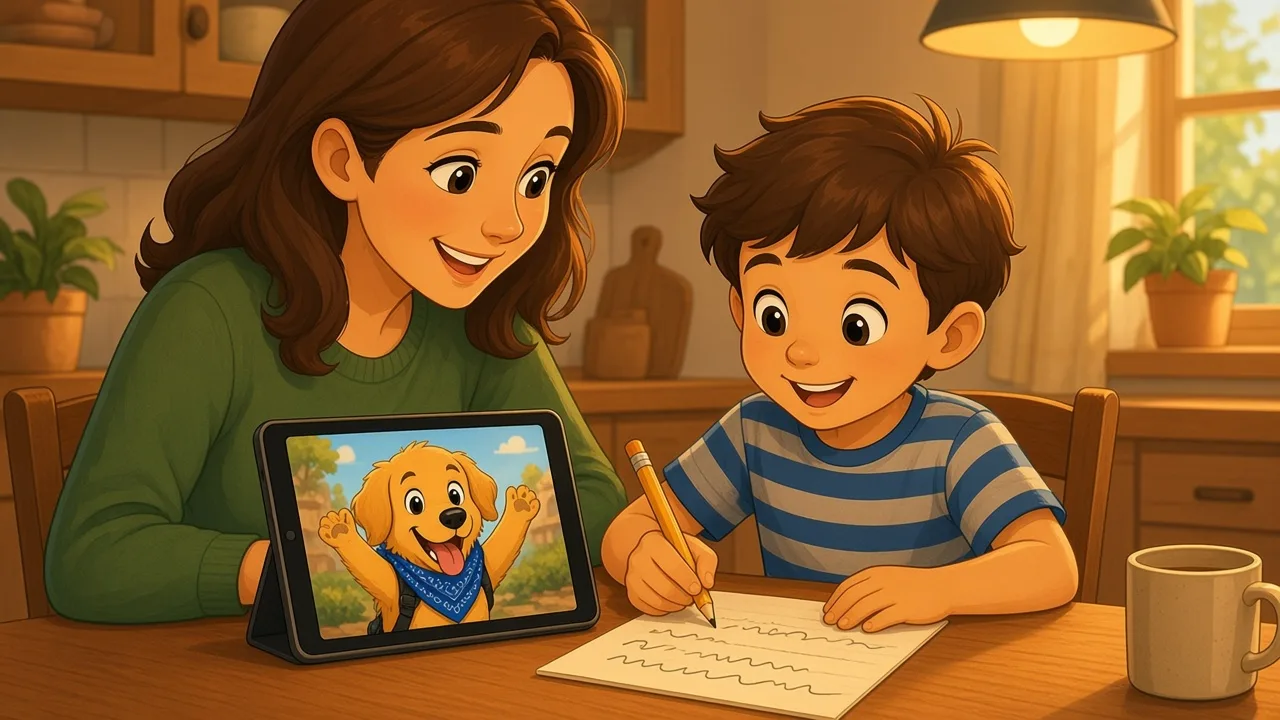
Fun Handwriting Practice Ideas
- Rainbow writing: Write one word, then trace it in three or four different colors.
- Sticky note hunt: Hide sticky notes with letters on them around the house. Your child finds each one and writes a word that starts with that letter.
- Shaving cream or sand letters: Write letters with a finger, wipe them away, and try again. Mistakes disappear instantly.
- Space finger: Have your child put a finger after each word to remember the space before starting the next word.
- Grown-up jobs: Let your child write the shopping list, address an envelope, or fill in the weekly calendar.
- Copy a favorite line: Pick one sentence from a favorite book and have your child copy it in their neatest writing.

What’s Included in the 12-Week Program?
Everything you need to build stronger reading skills, confidence, and a lifelong love of learning.
- Step-by-Step Reading Lessons Structured lessons matched to the reading skills your child needs to strengthen.
- Your Child’s Personalized Learning Path The assessment identifies where to begin, so your child works on the right skills — not simply material based on age or grade.
- Practice Activities & Progress Checks Fun, engaging activities reinforce each skill, with regular checks to see what’s improving and what still needs practice.
- Parent Teaching Guides Simple, step-by-step instructions show you exactly how to help — without needing teaching experience.
- Learn With Rocky or Learn Together Children who are ready can work more independently with Rocky, while parents who want to participate can follow Nancy’s guided approach.
- 12-Week Progress Reassessment & Report At the end of the program, your child completes a fresh assessment showing strengths, observed progress, remaining needs, and the recommended next learning step.
- Parent Support Included Join Motivation Mondays, Help Wednesdays, Friday Q&A with Nancy Barker. You don’t have to do this alone! You Have a WHOLE TEAM!
Quick & Easy Less Than 10 Min Assessment To Find Where Your Child May Be Falling Behind
Fill out the form and we’ll send you a free assessment to help you identify your child’s strengths and possible areas for growth.
A 10-Minute Handwriting Routine for Home
- Warm up hands (2 minutes): Squeeze playdough, make finger “spiders,” or do a few clothespin pinches.
- Model one letter family (2 minutes): Show and say the steps for two or three letters that start the same way.
- Practice (4 minutes): Write each letter a few times, then use it in two or three short words.
- Real writing (1 minute): Write one short sentence or label using those letters.
- Celebrate (1 minute): Circle the best letter and name what made it good.
How Handwriting Practice Changes by Age
Preschool
Focus on hand strength, drawing lines and circles, coloring, and learning to write their name. Many young children are still learning to hold a crayon, and that is normal.
Kindergarten and first grade
Focus on forming uppercase and lowercase letters from the top, sitting letters on the line, and leaving spaces between words. Read more about how to help a kindergartener with handwriting.
Second grade and up
Focus on neat, steady writing that is easy to read, writing a little faster without losing control, and writing full sentences and short paragraphs. Some schools also begin teaching cursive in these grades.
When to Ask for More Help
Talk with your child’s teacher if handwriting is not improving with steady practice, if writing is painful or very tiring, if your child avoids writing or gets very upset, or if handwriting is keeping them from showing what they know in class. A teacher can tell you how your child compares to classmates and what the school can offer. If you have concerns about a learning difference, fine motor development, vision, attention, or your child’s emotional well-being, talk with your child’s pediatrician or a qualified school specialist, such as an occupational therapist. Only a qualified professional can evaluate these.
Frequently Asked Questions
How long should my child practice handwriting each day?
About five to ten minutes is enough for most young children. Short, regular practice usually works better than long sessions, and it keeps writing from feeling like a punishment.
Are handwriting worksheets enough?
Worksheets can help, but they work best when you watch how your child forms each letter. Mix them with hands-on practice and real writing, like lists, cards, and labels.
Should I correct my child’s pencil grip?
Gently, yes, especially when a child is young and the habit is still forming. Short pencils, broken crayons, or a pencil grip can help, and if writing is painful or very tiring, ask your child’s teacher for advice.
Is it normal for my child to reverse letters like b and d?
Some reversals are a normal part of learning to write for young children. If reversals continue well after the early grades or happen along with other reading or writing struggles, talk with your child’s teacher.
Can neater handwriting help my child’s writing overall?
When letters come easily, children have more attention left for spelling, ideas, and sentences. That is why building smooth handwriting can support the rest of your child’s writing.
Find Out Where Your Child Is in Writing Today
Handwriting is one part of becoming a confident writer. Rocky Writing from Read Like Rocky, created by Dr. Nancy Barker, Ed.D., who has 49 years in education, starts with a free writing assessment that shows your child’s strengths and focus areas, so you know exactly what to practice next.
Take the free writing assessment
Want more? Read how to help your child write sentences and why some children hate writing.
About the author: Dr. Nancy Barker, Ed.D.; 49 years in education; Pepperdine literacy professor; creator of Read Like Rocky.
Research: Barker, N. (2011). Doctoral dissertation on Response to Intervention, Pepperdine University. Pepperdine Digital Commons.
This article is educational and not a medical or clinical evaluation. If you are concerned about your child, talk with your child’s teacher or pediatrician.
Quick & Easy Less Than 10 Min Assessment To Find Where Your Child May Be Falling Behind
Fill out the form and we’ll send you a free assessment to help you identify your child’s strengths and possible areas for growth.