
How Do I Help My Child Who Compares Themselves to Other Kids?

Quick & Easy Less Than 10 Min Assessment To Find Where Your Child May Be Falling Behind
Fill out the form and we’ll send you a free assessment to help you identify your child’s strengths and possible areas for growth.
When your child compares themselves to other kids, start by listening instead of correcting. Say something like: “It sounds like you noticed Maya finished faster, and that didn’t feel good.” Then gently turn their attention back to their own progress: “Let’s look at what you could do last month and what you can do now.” Children stop measuring themselves against classmates when they can clearly see their own growth, one small step at a time.
Comparing is a normal part of growing up. Children are always watching where they fit. The goal is not to stop them from ever noticing other kids. The goal is to help them use a better measuring stick: themselves, yesterday.
Why Kids Compare Themselves to Others
School makes differences easy to see
Reading groups, book levels, who finishes the worksheet first, who gets called on. Children notice all of it, even when adults try to keep it quiet.
They don’t yet see their own progress
Growth in reading, writing, and math happens slowly. A child can’t feel that they read a little more smoothly than they did in September. What they can see is the classmate who reads faster today.
Something feels hard right now
Comparison often shows up when a skill is a step or two above where a child is. “Everyone else can do it” usually means “I can’t do it yet, and that scares me.”
Siblings are right there
An older brother who reads chapter books or a younger sister who picked up letters quickly can make a child feel behind at home, too.
What Not to Say
- “Just don’t worry about other kids.” They can’t switch it off, and it tells them their worry doesn’t matter.
- “You’re better than them at other things.” This keeps the comparison game going. It just changes the scoreboard.
- “Your brother was reading by your age.” Comparisons from a parent hurt the most.
- “Everyone learns at their own pace” as the whole answer. It’s true, but on its own it can sound like a brush-off. Follow it with something concrete.
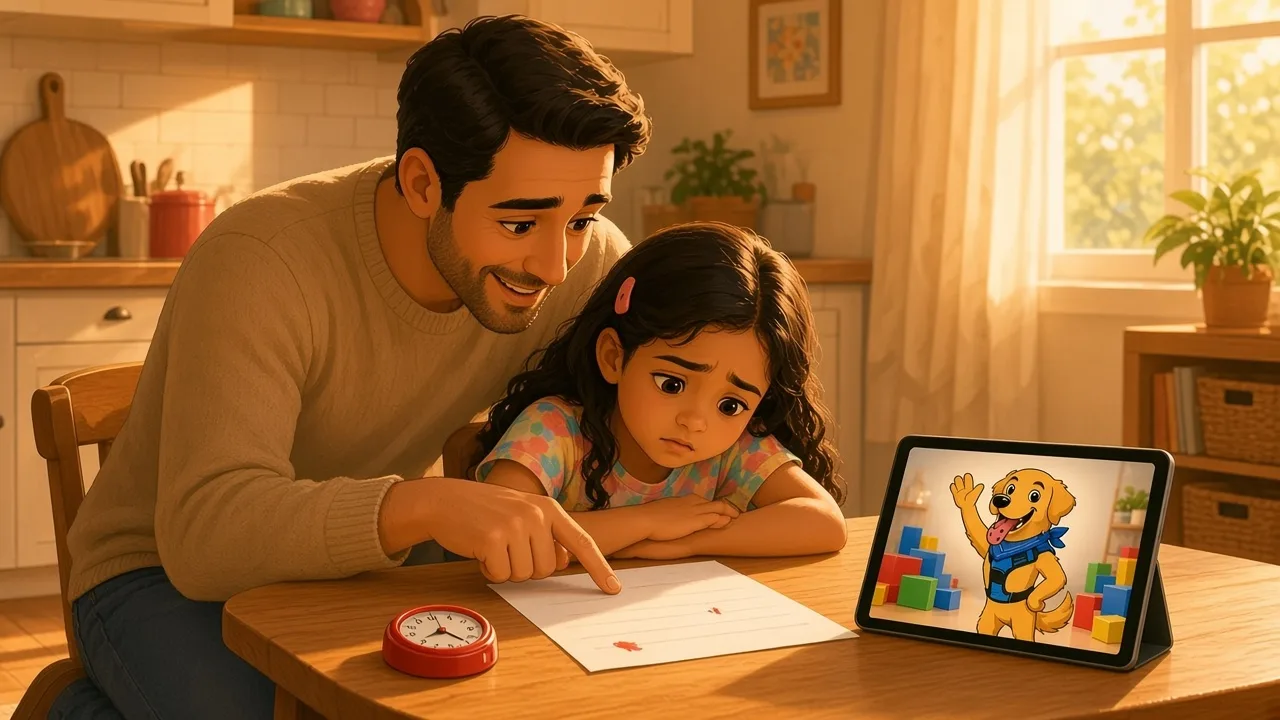
How to Help a Child Who Compares Themselves to Others: 7 Steps
1. Listen first and name the feeling
“You felt left behind today.” “That was embarrassing, huh?” When a child feels heard, they calm down and can actually take in what you say next.
2. Change the measuring stick
Teach a new question: “Am I better than I was before?” instead of “Am I as good as them?” Say it often, and use it about yourself too: “I couldn’t do this last year, and now I can.”
3. Make progress visible
Keep a simple “I can do it now” list on the fridge. Save an early writing sample and put it next to a new one. Record your child reading a page now and again in a few weeks, then listen together. Proof beats pep talks.
4. Practice at the right level
If every task feels harder than what classmates seem to do easily, comparison will keep coming back. Practice that is challenging but doable builds real success, and real success is what quiets “everyone is better than me.”
5. Praise effort and strategy, not ranking
Skip “You were the best in your group.” Try “You went back and fixed that word by yourself” or “You kept going even when that sentence was long.” This teaches your child that what they do matters more than where they place.
6. Talk about different strengths and different timelines
Share a time you learned something later than others, or a skill that took you a long time. Children feel less alone when they learn that adults they love had to practice too.
7. Talk with the teacher
Ask how your child is doing compared to grade-level goals, not compared to classmates, and what skill to practice at home. Let the teacher know your child has been comparing, so they can quietly encourage them at school.
A 1-Minute Script for Tonight
Parent: “You said everyone in your class reads better than you. That sounds like it’s been on your mind.”

What’s Included in the 12-Week Program?
Everything you need to build stronger reading skills, confidence, and a lifelong love of learning.
- Step-by-Step Reading Lessons Structured lessons matched to the reading skills your child needs to strengthen.
- Your Child’s Personalized Learning Path The assessment identifies where to begin, so your child works on the right skills — not simply material based on age or grade.
- Practice Activities & Progress Checks Fun, engaging activities reinforce each skill, with regular checks to see what’s improving and what still needs practice.
- Parent Teaching Guides Simple, step-by-step instructions show you exactly how to help — without needing teaching experience.
- Learn With Rocky or Learn Together Children who are ready can work more independently with Rocky, while parents who want to participate can follow Nancy’s guided approach.
- 12-Week Progress Reassessment & Report At the end of the program, your child completes a fresh assessment showing strengths, observed progress, remaining needs, and the recommended next learning step.
- Parent Support Included Join Motivation Mondays, Help Wednesdays, Friday Q&A with Nancy Barker. You don’t have to do this alone! You Have a WHOLE TEAM!
Quick & Easy Less Than 10 Min Assessment To Find Where Your Child May Be Falling Behind
Fill out the form and we’ll send you a free assessment to help you identify your child’s strengths and possible areas for growth.
Child: (shrugs or nods)
Parent: “Here’s what I noticed. Two weeks ago, this word stopped you. Today you read it without help. That’s you getting better. Want to pick one more thing to practice together, just five minutes?”
When to Look Closer
If your child often says they are “the worst,” avoids reading or homework, or seems to be falling further behind, it is worth finding out exactly which skills need support. Knowing where your child is gives you a clear place to start, and it turns a vague worry into small steps you can practice. If you are worried about your child’s mood or wellbeing, talk with your pediatrician or school counselor.
Frequently Asked Questions
Is it normal for kids to compare themselves to others?
Yes. Comparing is a normal part of growing up. It becomes a concern when it stops a child from trying or leads them to call themselves names.
How do I stop my child from comparing themselves to siblings?
Avoid comparisons yourself, give each child one-on-one time, and celebrate each child’s progress against their own past work, not against each other.
How can I build my child’s confidence in reading?
Practice at the right level, show them proof of how far they’ve come, and praise effort and strategies. Confidence grows from real, repeated success.
Help Your Child See Their Own Progress
Read Like Rocky, created by Dr. Nancy Barker, Ed.D., who has 49 years in education, starts with a free assessment that shows your child’s strengths and focus areas in reading, writing, and math, so you can practice at the right level and celebrate each step forward.
You can also read what to say when your child says “I’m dumb” and how to build confidence in a child who says they’re bad at reading.
About the author: Dr. Nancy Barker, Ed.D.; 49 years in education; Pepperdine literacy professor; creator of Read Like Rocky.
Research: Barker, N. (2011). Doctoral dissertation on Response to Intervention, Pepperdine University. Pepperdine Digital Commons.
This article is educational and not a medical or clinical evaluation. If you are concerned about your child, talk with your child’s teacher or pediatrician.
Quick & Easy Less Than 10 Min Assessment To Find Where Your Child May Be Falling Behind
Fill out the form and we’ll send you a free assessment to help you identify your child’s strengths and possible areas for growth.